Double Rainbows and Kidnapped Movie Stars: The Manufactured World of Kim Jong Il
North Korea said Kim Jong Il was born under a double rainbow on a sacred mountain. Soviet records put his birth in a Siberian village. Between the myth and the record lies a life of film vaults, kidnapped stars and cognac.
North Korea's official biography says Kim Jong Il was born in a log cabin at a secret guerrilla camp on Mount Paektu, the sacred peak on the Chinese border, and that nature marked the moment: his coming was foretold by a swallow, a double rainbow arched over the mountain and a new star appeared in the sky. Soviet records tell a different story. They show a boy named Yuri, born in 1941 in the Soviet Far East, where his father, Kim Il Sung, commanded a battalion of Korean and Chinese exiles in the Red Army. Historians generally place the birth at a military camp near Khabarovsk - the village of Vyatskoye is the most often named, though some researchers argue for the Voroshilov camp. The official year, 1942, was settled on decades later; scholars note that it aligned his birth neatly with his father's revolutionary legend. Between those two births - one documented, one invented - lies the key to how Kim Jong Il ruled: as the producer of a national fiction with himself at its centre.
A birth, and a death, announced by the weather
Kim spent his early career running the machinery that manufactured such stories. He joined the party's Propaganda and Agitation Department in 1966, led it from 1973, and built the personality cults of both his father and himself, before being publicly designated as successor in 1980. The myth-making bookended his life. When he died, state media reported that a fierce snowstorm suddenly paused, that the ice on Lake Chon, on Mount Paektu, cracked with a sound that shook heaven and earth, and that the sky above the mountain glowed red. Outside North Korea, almost nothing about him could be verified in real time. There was no independent press and no access; foreign knowledge rested on defectors, diplomats and intelligence agencies. That is why so much of his private life is still described by historians with the words "reported" and "according to" - and why the verifiable episodes stand out so sharply.
The producer who kidnapped his cast
The best documented of those episodes grew out of a genuine obsession. The BBC's obituary noted that his love of cinema "bordered on the obsessive": he was said to have assembled a personal library of more than 20,000 films, he wrote a treatise, On the Art of the Cinema, and his reported favourites ranged from James Bond and Rambo to Godzilla films, with Elizabeth Taylor his favourite actress. Dissatisfied with his own studios, he reached for the South's talent. In 1978, North Korean agents lured the actress Choi Eun-hee to Hong Kong and abducted her; her former husband, the director Shin Sang-ok, travelled there to search for her and was seized as well. By the couple's later account - told in memoirs and reconstructed in Paul Fischer's 2015 book A Kim Jong-Il Production - they were held apart for five years, Shin spending part of that time in prison after escape attempts. Reunited at a banquet in 1983, they were given studios, budgets and foreign travel, and made seven films, most famously Pulgasari (1985), a monster epic created with special-effects technicians from Japan's Toho studios. Choi secretly tape-recorded her conversations with Kim. In 1986, during a trip to Vienna, the couple escaped into the American embassy. Pyongyang denied any kidnapping and insisted they had come voluntarily, a claim historians reject: the recordings and the couple's consistent testimony corroborate each other.
Cognac, lobsters and the armoured train
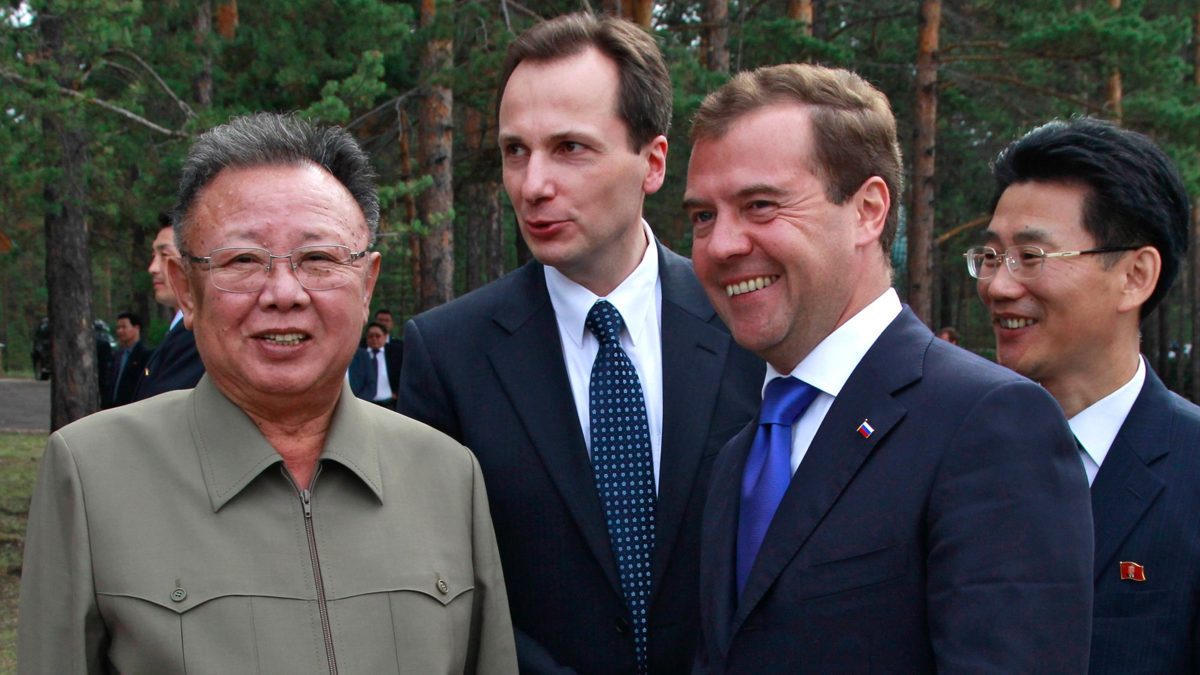
His private tastes were nearly as extravagant as his productions, though here the record rests more heavily on defector and diplomatic testimony. Kim reportedly feared flying - a Swedish ambassador who knew Pyongyang in those years attributed the fear to a 1976 helicopter crash in which he was injured - and so he crossed his own country, and travelled to China and Russia, in a slow armoured train, with decoy trains running alongside. Konstantin Pulikovsky, the Russian envoy who accompanied him on the long rail journey to Moscow in 2001, told the BBC that live lobsters were airlifted to the train each day and that Kim ate them with silver chopsticks. Trade figures cited by the Wall Street Journal and other outlets in the 1990s suggested he was the world's largest single buyer of Hennessy's premium cognac, importing an estimated $650,000 to $800,000 worth a year - this in a country where famine was killing, by aid agencies' estimates, hundreds of thousands of people. He died, the state announced, of a heart attack aboard his train on 17 December 2011: a final scene, like his birth, reported only by the state that had staged his life.