Baba Vanga: The Blind Mystic Whose 'Prophecies' Still Haunt the Headlines
She died in 1996 without writing down a single prophecy, yet every year 'Baba Vanga's predictions' fill the headlines. The story of the blind Bulgarian mystic — and of how her legend was built after the fact.
Every December, like clockwork, the headlines return: 'Baba Vanga's terrifying predictions for the year ahead.' The lists promise wars, disasters, alien visitors and economic collapse — all attributed to a blind Bulgarian grandmother who died in 1996 and never wrote down a single prophecy. Few modern legends better show how a reputation for seeing the future can be built, and rebuilt, entirely after the fact.
Vangeliya Pandeva Gushterova was born on 3 October 1911 in Strumica, then in the Ottoman Empire and now in North Macedonia. According to the account she and her biographers told, a whirlwind caught the 12-year-old, flung her into a field and left her eyes packed with sand and dust. Her poor family could not pay for full treatment, operations failed, and she gradually lost her sight. In 1925 she was sent to a school for the blind in Zemun, where she learned Braille and practical skills before returning home to care for her younger siblings.
A village seer on the communist payroll
Vanga's fame began during the Second World War, when she was living in Petrich, in Bulgaria's south-west, and distraught families came asking what she could tell them about soldiers missing at the front. Word spread that her answers were uncannily accurate, and Bulgaria's Tsar Boris III reportedly visited her. After her husband Dimitar died in 1962, the stream of visitors only grew, arriving from across the Eastern Bloc.
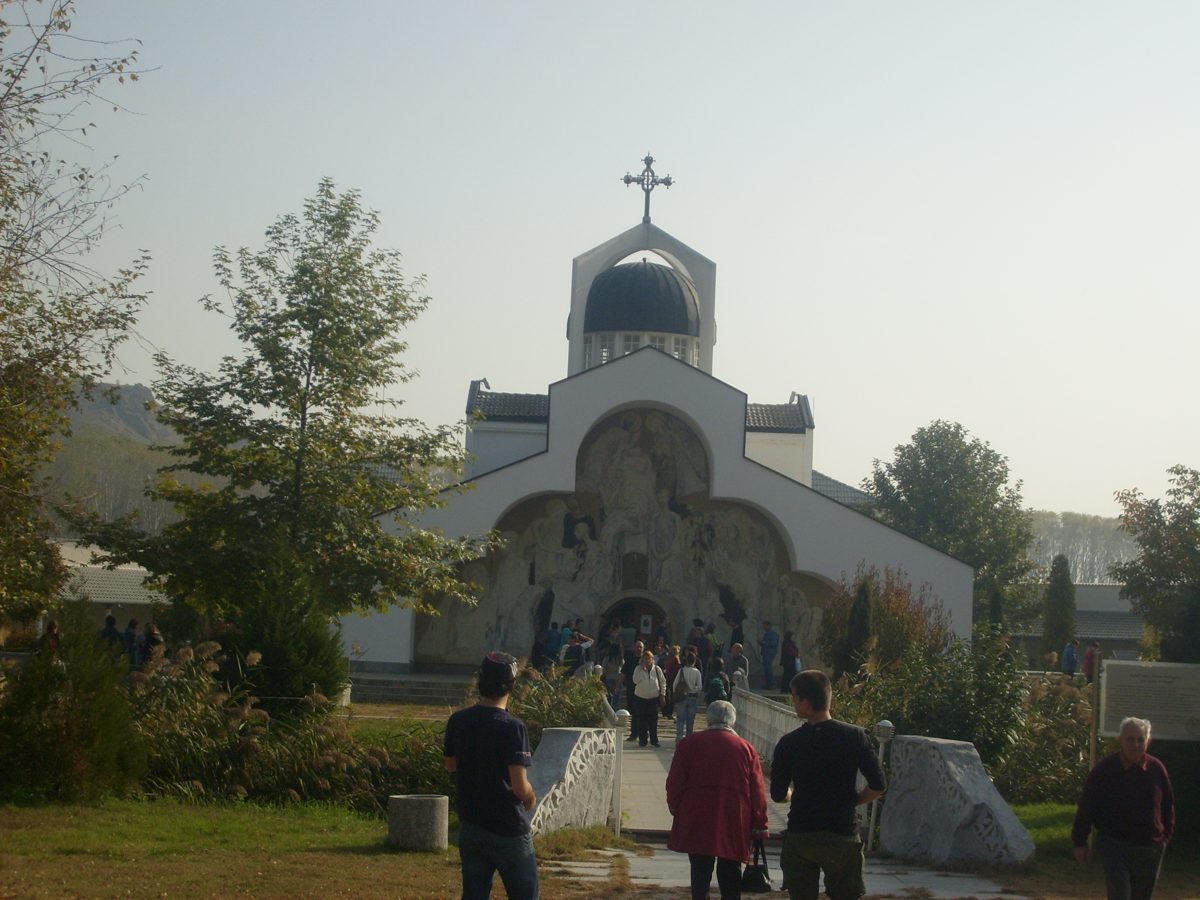
Communist Bulgaria, officially atheist, first tried to suppress her, then made an unusual accommodation. In the 1960s the state-backed Institute of Suggestology, led by psychologist Georgi Lozanov, began studying her sessions, and Vanga was put on the payroll of the Petrich municipality and the institute. Visitors were registered and charged a fee — less for Bulgarians, more for foreigners — and senior party officials, reportedly including Soviet leader Leonid Brezhnev, consulted her in private. Late in life she settled at Rupite, a village near an extinct volcano that she considered a source of energy. With money left by visitors she had a church built there, dedicated to St Petka and consecrated in 1994; its murals, which depict Vanga herself, drew objections from the Orthodox Church, since only saints may be shown that way. She died of breast cancer on 11 August 1996 and was buried beside the church. Her houses in Petrich and Rupite are now museums.
The prophecies her followers cite
The claims that made Vanga world-famous surfaced mostly after her death. Followers say she warned that 'Kursk' would end up under water and the whole world would mourn it — words matched, in August 2000, to the sinking of the Russian nuclear submarine Kursk, with the loss of all 118 men aboard. A phrase followers date to 1989 — that American brethren would fall after being attacked by 'steel birds' and innocent blood would gush — is quoted in every retelling of the September 11 attacks. She is also credited with foreseeing the dissolution of the Soviet Union, the Chernobyl disaster, the 2004 tsunami and the election of Barack Obama as America's first Black president, its 44th.
The annual lists go further, assigning her a dated forecast for almost every future year. The current crop attributed to her for 2026 includes a third world war, devastating natural disasters, machines displacing human workers and, in November, first contact with an alien spacecraft — a schedule that conveniently mirrors the anxieties already filling the news.
What the record actually shows
Here is the problem that historians and sceptics keep returning to: Vanga left no written predictions at all. Semi-literate and blind, she dictated nothing for posterity; what she said in her sessions was noted, or remembered, by staff and visitors. Several people close to her have stated plainly that she never made some of the prophecies now attached to her name. No dated document from her lifetime records the 'steel birds' line or the Kursk warning — they appear in books, newspapers and websites after the events they supposedly foresaw.
The failures, by contrast, rarely make the lists. Attributed forecasts that a nuclear war between 2010 and 2016 would empty Europe, that the 1994 World Cup final would feature two teams beginning with 'B', and that Obama would be America's last president all failed to happen. Scholars who study the Vanga phenomenon describe the pattern as retrofitting: vague or unverifiable sayings are held against the news until something fits, hits are repeated for decades, and misses quietly expire. The yearly prediction lists, assembled by tabloids and content sites, need no source material at all — only her name.
None of this has dented her following. At Rupite, visitors still light candles at her church and grave, and across south-eastern Europe 'Baba Vanga' — Grandmother Vanga — remains a household name. Her story endures less as evidence of prophecy than as a lesson in how legends are manufactured: one part genuine wartime consolation, one part state-sponsored curiosity, and a large part an internet that never lets a good prediction go unchecked.