The Secrets of Jeff Bezos: The Empty Chair, the 80-Year-Old Test and the Taxes He Did Not Pay
Jeff Bezos built Amazon around rules few outsiders ever saw: meetings that begin in silence, a chair left empty for the customer and life decisions judged from the age of 80. His biographers also found the numbers he never publicized.
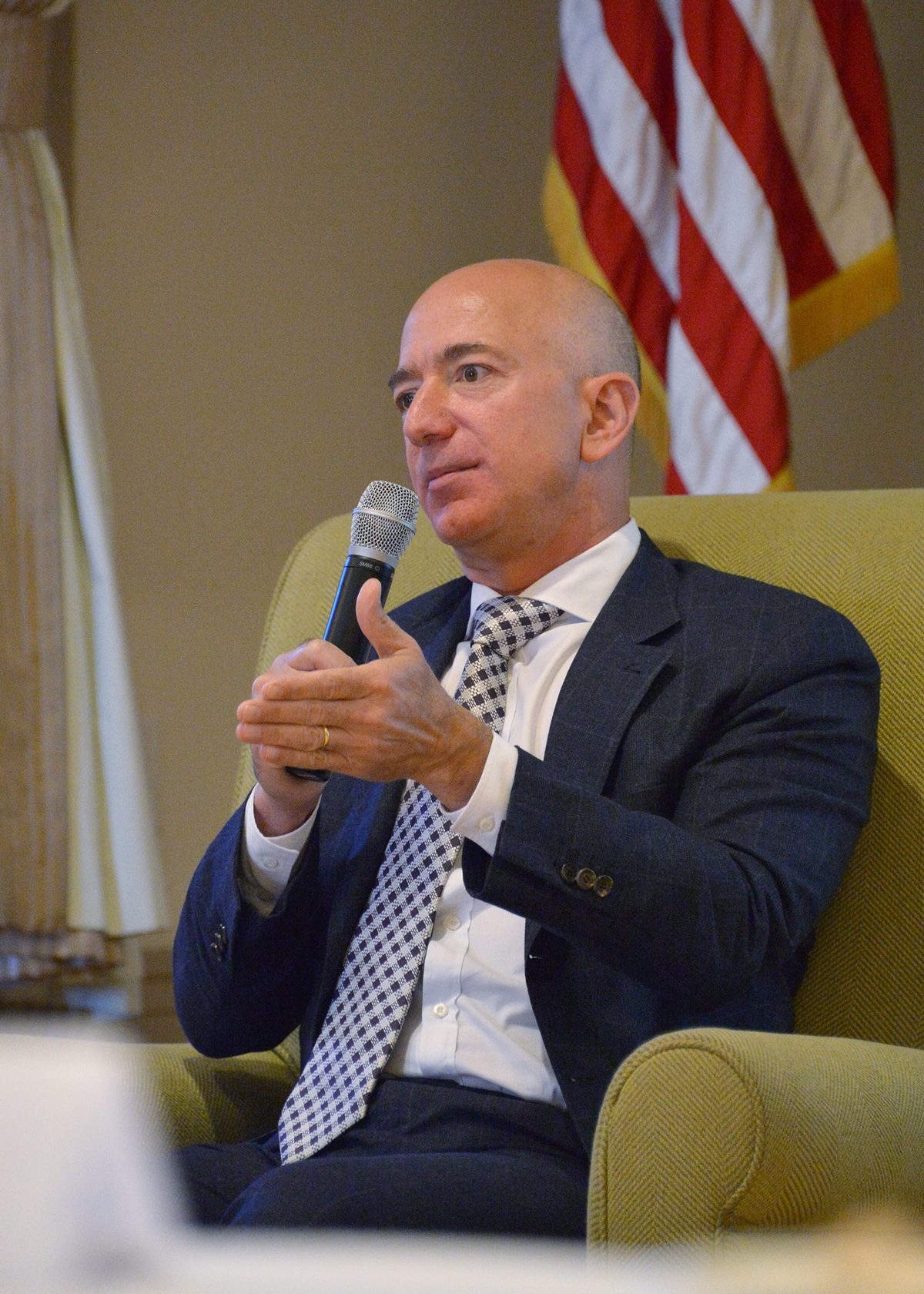
Jeff Bezos spent twenty-seven years as the public face of Amazon, yet the most revealing details of how he actually works come not from his keynote speeches but from the small rules reported by his biographer Brad Stone and from Bezos's own shareholder letters and interviews: meetings that begin in silence, a chair deliberately left empty, and the biggest decision of his life made by imagining himself at eighty years old.
Born Jorgensen: the name he did not start with
Bezos was born Jeffrey Preston Jorgensen in Albuquerque, New Mexico, in 1964, to a mother who was still a teenager. His stepfather, Miguel Bezos, a Cuban immigrant who arrived in the United States alone as a teenager, adopted him when he was four. According to Stone's The Everything Store, Bezos was about ten when he learned that the man raising him was not his biological father; his biological father, Ted Jorgensen, was a former circus performer and bike-shop owner whom Stone tracked down in Arizona. Stone reported that Bezos, who regarded Miguel as his real father, showed little interest in a reunion, and Jorgensen said he had not known the boy he gave up had become one of the world's richest men.
As a toddler, his mother recalled to Stone, Bezos dismantled his crib with a screwdriver because he wanted a real bed. Summers were spent on his grandfather's ranch in Texas, repairing windmills and working cattle.
The rules nobody sees: silence, memos and an empty chair
Inside Amazon, according to Stone's reporting, Bezos banned PowerPoint in senior meetings. Proposals are written as narrative memos of up to six pages, and meetings open with everyone reading in silence for as long as half an hour before anyone speaks — a practice Bezos has defended publicly by saying it forces clear thinking. Teams were kept small enough to be fed by two pizzas. In early meetings, Stone reported, Bezos would leave an empty chair in the room to represent the customer, "the most important person in the room."
His personal operating rules are equally deliberate and have been described by Bezos himself in interviews. He has said he wakes without an alarm, protects his mornings, schedules his hardest meetings for around ten o'clock, and aims to make only about three good decisions a day. He has also said he insists on eight hours of sleep. Since 2015 his shareholder letters have divided decisions into "one-way doors," which are irreversible and must be made slowly, and "two-way doors," which can be reversed and should be made fast.
The framework behind the biggest door of all is the one he described to the Academy of Achievement in 2001. Deciding in 1994 whether to leave a senior job at the hedge fund D.E. Shaw to sell books on a new thing called the web, he "projected himself to age 80" and asked which choice he would regret. Failure, he concluded, would not haunt him; never trying would. He quit, and drafted Amazon's business plan while his then wife, MacKenzie, drove them across the country to Seattle.
The numbers he never publicized
Some of the best-documented facts about Bezos are the ones that emerged only through leaks and filings. In 2021 ProPublica, working from a trove of confidential Internal Revenue Service records, reported that Bezos paid no federal income tax in 2007 and again in 2011 — in the second of those years he was worth an estimated $18 billion and, ProPublica reported, claimed a $4,000 tax credit for his children. The reporting stressed that this was legal: his fortune sat in Amazon stock whose rising value is not taxed as income until it is sold. Bezos did not comment directly on the figures at the time, and Amazon pointed reporters to his later investments and philanthropy.
Other numbers were simply expensive. Amazon's Fire Phone, a project Bezos championed personally according to Stone, produced a write-down of about $170 million in 2014 and was discontinued within a year. His rocket company, Blue Origin, was founded in 2000 but operated so quietly that its existence was barely known for years; Bezos later confirmed in interviews that he funds it by selling roughly $1 billion of Amazon stock a year. In 2013 he bought The Washington Post personally, for $250 million in cash, through a holding company rather than Amazon.
His private life produced one more public record he did not choose. In 2019 Bezos and MacKenzie announced their divorce after twenty-five years in a joint statement; under the settlement she received about 4 percent of Amazon's shares, while he kept the larger stake and voting control. The same year, an investigation Bezos commissioned concluded, his security consultant Gavin de Becker wrote publicly, that his phone had been compromised. In 2020 a United Nations report said investigators had "reasonable certainty" the phone was hacked in 2018 through a WhatsApp message from an account associated with Saudi Arabia's crown prince — an allegation Saudi Arabia denied, and which has never been resolved in public.